

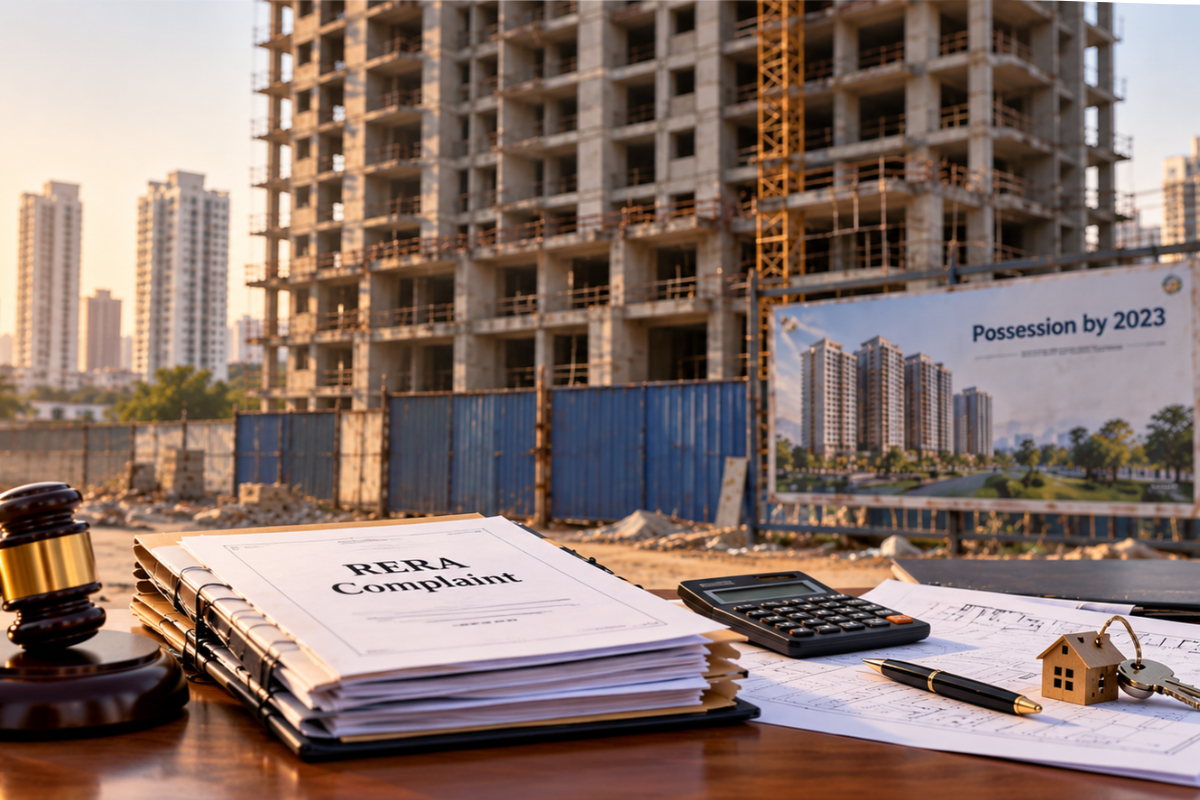
You signed the agreement, paid most of the price, and started planning the move. The possession date came and went. The builder keeps sending new timelines, and meanwhile you’re paying rent and an EMI on a flat you can’t live in.
The Real Estate (Regulation and Development) Act, 2016 gives you a way out of this. A RERA complaint for delayed possession lets you either claim interest for every month of delay or walk away with a full refund plus interest. This guide explains your rights, how the interest is worked out, and how to file a complaint before the Delhi Real Estate Regulatory Authority (DRERA).
What the Law Says About Delayed Possession
Section 18 of the RERA Act covers this. If the builder fails to complete the project or hand over the unit by the date in your agreement for sale, you get to choose between two remedies:
- Withdraw from the project. The builder must return everything you’ve paid, with interest, and compensation where applicable.
- Stay in the project. The builder pays you interest for every month of delay until it hands over possession.
The Supreme Court settled how strong this right is in Newtech Promoters and Developers v. State of UP (2021). The Court held that the right to a refund under Section 18(1) is unconditional. The builder can’t avoid it by pointing to a clause in the agreement or blaming the delay on something outside the buyer’s control.
Builders often rely on one-sided clauses that cap delay compensation at ₹5 or ₹10 per square foot. In Pioneer Urban Land v. Govindan Raghavan (2019), the Supreme Court held that buyers aren’t bound by such unfair terms. RERA authorities now award interest at the statutory rate regardless of what the builder’s agreement says.
How Much Interest Can You Claim?
The rate comes from each state’s RERA Rules. Delhi and Haryana use SBI’s highest Marginal Cost of Funds-based Lending Rate (MCLR) plus 2%. Uttar Pradesh uses MCLR plus 1%, which matters if your project is in Noida or Greater Noida. In early 2026, SBI’s highest MCLR was 8.80%, so the Delhi rate worked out to about 10.8% a year. Check SBI’s website for the current figure before you file.
The same rate applies in reverse. If you pay an instalment late, the builder can charge you interest at this rate too.
A simple example:
- Amount paid to the builder: ₹60,00,000
- Delay beyond the agreed date: 18 months
- Rate: 10.8% per year
₹60,00,000 × 10.8% × 1.5 years = ₹9,72,000 in delay interest
Interest runs from the promised possession date (after any grace period the agreement allows) until the builder offers possession with an occupancy certificate. If you’ve already taken possession, you can still claim for the months of delay that came before it.
Refund or Interest: Which Should You Choose?
This depends on the project more than the law.
Ask for a refund if construction has stalled, the builder is in financial trouble, approvals are pending, or you’ve simply lost faith in the project. You get your money back with interest from the date of each payment.
Stay and claim interest if the building is close to completion, the location still suits you, and property prices in the area have risen since you booked. Buying a similar flat today may cost far more than the refund you’d receive.
Look at the project’s quarterly updates on the DRERA portal before you decide. Builders must upload construction progress there, and the gap between their promises to you and their filings to the regulator often tells you a lot.
Documents You’ll Need
Gather these before filing:
- Allotment letter and agreement for sale (or builder-buyer agreement)
- Payment receipts and bank statements showing every amount paid
- Home loan sanction letter and EMI statements, if you took a loan
- Emails, letters and messages from the builder about delays or revised dates
- Any demand letters from the builder
- The project’s RERA registration number (on the DRERA portal or the builder’s ads)
- Rent agreements, if you’ve been renting while you wait
Keep a simple timeline of payment dates, the promised possession date and each revised date the builder gave you. It makes drafting much easier.
How to File a RERA Complaint in Delhi: Step by Step
Step 1: Send a legal notice first. It isn’t mandatory, but a notice giving the builder 15 days to hand over possession or refund your money puts your demand on record. Some builders settle at this stage.
Step 2: Confirm the project’s RERA registration. Search the project on the DRERA portal and note the registration number. Complaints are filed where the project sits. A Gurugram project goes to HRERA and a Noida project goes to UP RERA, even if you live in Delhi.
Step 3: Pick the right forum within RERA. Refund and interest under Section 18 go to the Authority. A claim for further compensation, such as mental harassment, rent paid, or other losses, goes to the Adjudicating Officer under Section 71. Many buyers file both.
Step 4: Draft the complaint. Set out the facts in date order, name the sections of the Act the builder has breached, and state exactly what you want: the refund amount with interest, or monthly delay interest until possession. Attach your calculation.
Step 5: File online and pay the fee. Register on the DRERA portal, fill in the complaint form, upload your documents and pay the filing fee shown on the portal.
Step 6: Attend the hearings. The authority issues notice to the builder, who files a reply. The Act asks the authority to decide complaints within 60 days, though hearings in contested matters often take several months.
Step 7: Enforce the order. If the builder doesn’t pay, apply to the authority to recover the amount as arrears of land revenue. The authority can also impose penalties for non-compliance. Either side can appeal to the Real Estate Appellate Tribunal within 60 days of the order.
RERA or Consumer Court?
You don’t have to choose RERA. Section 88 says RERA remedies are in addition to other laws, and the Supreme Court confirmed in Imperia Structures v. Anil Patni (2020) that buyers can approach the consumer commission instead.
RERA is usually faster and cheaper for straightforward refund or interest claims. The consumer commission can suit cases where you’re seeking large compensation for deficiency in service. You can’t pursue the same relief in both forums at once, so pick one early.
When to Bring in a RERA Lawyer
Plenty of buyers file simple complaints on their own. A RERA lawyer is worth it when:
- The builder argues force majeure, pending approvals, or a clause that seems to excuse the delay
- You’re claiming a large refund, or compensation beyond statutory interest
- Several buyers in the same project want to file together
- The builder has an order against it but still isn’t paying
- The builder is facing insolvency proceedings, which changes where and how you claim
An experienced real estate lawyer in Delhi can also check whether your agreement matches the RERA model agreement, calculate interest correctly from each payment date, and handle the builder’s reply so your claim isn’t cut down on a technicality.

